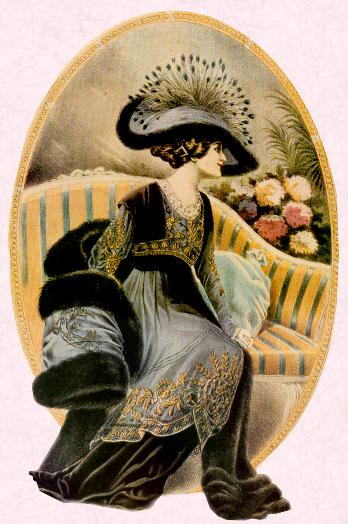
My maidservant is absent, ‘tis true, but slight gladnesses brighten my sagging spirits. ‘Tis all a lady can do: one must distract oneself with pleasant diversions and even more pleasant thoughts when one’s maidservant dies a gruesome death on an abortionist’s filthy table. I’ve no one to tighten my corsets, save Minnie, the foyer’s maid, but her hands are most gruesomely wizened with age and labor, and I swoon more easily when I feel her rough skin brush against my glowing, satin-y skin, aged a mere 19 years. I allow my nurse-maid, Tillie, to tend to my corsets when she makes her weekly call, but alack! her visits are too infrequent, and she grumbles over the task.
And who is there to tend to my silken tresses? Dear Marguerite can help, of course, and her own maid-servant, Birdie, yet all their efforts do not achieve the same effect as the wretched Orpha was able to achieve. ‘Tis true, Celtic blood flowed in her wretched veins, but in spite of this flaw she was a brilliant coiffeuse.
But Papá and Step-Mother Celestine have been of great assistance to my emotional frailty, as has the dashing Horace. At twilight he calls with his euphonium. He arrives directly from his job managing his father’s haberdashery. Ah, the work that men do! I do not believe I should choose to possess the intellectual and social superiority of a gentleman if a requirement of this superiority be the hard toil that a man must endure! I should choose to remain in my gentle state, quietly resting away the hours of my blissful life, far from the exhausting energy required of one who spends his days in the world of industry!
Horace brought me a new fan from the Orient to add to my collection, adorned in peacock feathers and various filigrees most pleasing to my blue eyes. And, in what is certainly a symbol of glad tidings, to-day my little nieces Millie and Florrie rushed into the Gazebo at the back of the estate, where I was engaged in daydreams most whimsical, and they were in a very excited state.
“See what came by post today, Auntie Katharina!” Said Millie.
And they each opened their hands to reveal a little swastika pin and thimble which is the beneficiary of all those with membership in the Ladies’ Home Journal’s Girls’ Club!
“How wonderful!” I cried. “’What every girl wants – her own swastika!’” I said, reciting the well-known slogan of the Girls’ Club.
“We shall wear the pins proudly on our taffeta!” Said Florrie.
This sent me into peals of laughter. “Why, you mustn’t ruin your good taffeta dresses in such a fashion, you naughty little girls!”
“Oh, Florrie, you kid so,” Millie admonished her twin sister. “Of course, we shall display them only on our wool coats come winter.”
“There’s a good girl,” said I.
“Auntie Katharina,” said Florrie, blushing a bit, “you are so kind to us, I want you to have this. I’ve no use for it.” She extended her hand to deliver the little thimble into my own.
“Why, what a good deed you have done, Florrie! You are most suited for membership in the Girls’ Club!”
I was most touched by this little gesture; of course, I have no use for a thimble either; sewing would coarsen my fingers so, but I shall display it proudly on my dressing-table! The swastika, that ancient token of good fortune and all-‘round joy, could never have any unpleasant associations! No, when I gaze upon it, I feel only comfort, as it ever shall be with the swastika!

20.1.12
The Glad Swastika

14.1.12
Pictorial images for the reader's edification

My brother, Archibald Pierce van Seethinbottom, aged half a decade.

And me, at the same sitting, aged 6. The occasion for the photographs was this: I was temporarily deprived of my wretched maidservant, Orpha, for this was the third time she had contracted diphtheria and she was quarantined with the pigs and other contagious servants on a farm about a dozen furlongs distant. I was livid at her selfishness in failing to avoid miasmal air and so sickening herself, thus forcing Mamá or one of my sisters to curl my ringlets, tighten my corsets, tidy my playthings, and drive my play rickshaw (the former, of course, they refused to do, and so I was left rickshaw-less for the duration of Orpha's illness). Mamá decided to cheer me up by taking brother Archibald (whose manservant, Albert, was quarantined with polio) and me on a trip to the Adirondacks, during which time we both sat for photos. So the wretched Orpha's bout with diphtheria had a happy ending for me after all! (Not, though, for Orpha, who to this day experiences tingling in the extremities due to her manifold exposures to the dreaded disease.)
23.12.11
Merry!
Ah, how Christmas-time makes my heart leap with joy! O the gaiety! O the merriment! O the poor orphaned children begging in the street; how the pennies do flow into their threadbare caps via the hands of benevolent souls throughout the month of December! 'Tis enough to make one sing and weep with joy, simultaneously! And Dr Schultheiß says I am rid of my consumption! Can there be a happier lass on Papá's estate?
Whate'er reason I may have for ungratefulness, at the very least my Yuletide sha'n't be passed in the fashion of the waifs above! Hooray, I am wealthy!

21.7.11
I adore ships
One of the great passions of my life has been sea-faring. One would not know this to gaze upon my pale visage and feeble constitution, but an adventurous streak runs through me as surely as the Mississippi River runs through some of the more pastoral of the 46 states of our glorious nation! I insist on being the first on the passenger list of any new ship that is christened; ‘tis fortuitous that Papá is none other than the eminent industrialist, Adolphus Hilliard van Seethinbottom III, for he is able to easily secure my passage on any great vessel which may sail the mighty seas (but not, dare I say, the vile Black Sea; once one passes through the straits of Dardanelles, one may witness a dizzying array of malfeasant activities committed by the various unsavoury peoples that populate her shores. Likewise, I should not like to travel too close to the horrendous shores of old Eire). By far the most exciting ocean liner I have sailed on was the RMS Mauretania. I insisted on journeying on her maiden voyage from Liverpool, a fetid, plebeian city which will never yield any productive or renowned citizens. The Mauretania’s interior was as stately as Mr. Rockefeller’s summer cottage; its meals as lavish as I could expect from the finest hotels of Paris or Monaco.
At this moment in Britain the White Star Line has undertaken the daunting task of constructing three ships that shall rival even the largest and most opulent liners of the grand Cunard Line. The RMS Olympic sailed on her maiden voyage last month, and I threw a fit unbecoming of a lady when Papá refused to grant me permission to be the first to board, due to my recent psychic maladies. However, White Star is working on two sister ships, the RMS Gigantic and the RMS Titanic, the latter of which was launched earlier this year and shall embark on her maiden voyage in the spring. Certes, to be seen on her hull as she departs the brackish waters surrounding Merrie Olde England will be the society event of the year. In addition to being the most luxurious of ships, pioneers of seafaring technology are deeming these ships positively unsinkable, due to their extra-ordinary engineering. It is my greatest hope that Drs. Weißmüller, Frankenthaler, et al. pronounce me well by April of next year so that I may participate in this historic event.
The grand RMS Olympic leaving port.

2.6.11
A Letter for Orpha
The wretched servant girl, Orpha, was filled with glee when this arrived for her in the post-box morning last:
"A postal card? For me?" We were all of us shocked and gathered in the foyer to examine the mysterious arrival.
I simply could'n't help myself: I burst into laughter! "Why, whoever would want to correspond with an illiterate scullery maid?"
"I'm afraid I don't know, madam," she replied in her lower-class brogue. "Mail has never arrived for me before. Please, tell me what it says."
My sister Marguerite quickly snatched the thing and began to peruse it. She tittered, then announced, "I'm so terribly sorry, Orpha, but they seem to have reached you in error. They were looking for one Orpha O'Callaghan, to be sure, but certainly not you. Your name must be common enough amongst the race of Irish-Iberians to which you belong."
Orpha looked crestfallen. Meekly, she stammered, "Well -- may I ask, Miss Marguerite, what the letter says?"
"Er...I shall read it verbatim. Dear Mrs. O'Callaghan -- you are certainly not married, are you, Orpha?" Marguerite teased.
Again, my laughter could not be contained. "The very idea!" said I, "A suitor willing to offer a hand in marriage to Orpha? Why, he would have to be a Scotsman!"
"Quiet down, Katharina. You are such an impetuous sort!" Marguerite continued: "We had occasion to visit Galway Inn and Stables in May and are writing to extend our thanks anew for your gracious hosting of us in your fine inn whilst we journeyed in America. The next time we find occasion to cross the sea, we shall certainly remember your establishment, and we shall recommend it to all our acquaintances. Sincerely, Lord Ashby Clive Mortimer Hollingberry and Lady Philippa Hallybone Hollingberry. Why, Miss Orpha!" Marguerite feigned shock, "You didn't inform us that you were both an equestrienne and a proprietress! And that you are hosting the British nobility at your inn!"
Miss Orpha! Imagine! Marguerite has always played the rôle of the clown, and her reversal of the polite address system in this instance made me nearly fall to the hand-woven Constantinople carpet in hysterics!
Orpha, in her simple Gaelic mind-set, was unable to grasp the nuanced humour. She continued to look dejected. "I ... I s'pose they had in mind a different Orpha O'Callaghan..." She shuffled off, the limp in her left foot taking on a pronounced stagger. (The limp is a relic of a childhood injury; Mamá, furious with Orpha for not properly curling my ringlets, pushed her out of a briskly paced buggy.) Poor wretched Orpha!

29.3.11
A tragic event in the city
A horrible tragedy this week in Man-hattan. Fire consumed the Triangle Shirtwaist Factory, located in the Asch Building near Washington Square. Scores of Germanic, Slavic, and Italic girls perished in the inferno; a goodly number jumped to their deaths. A witness described the frightening thud of bodies on the pavement as some sixty girls jumped 9 stories to their death. Some were as young as 12; they died fifteen years before their time. Horrors!
Despite the tragedy, one must remark on how the downtrodden often bring such misfortune on themselves through their heedlessness and haste. Witnesses remarked that the factory was in a disarray, with scraps of fabric and paper patterns strewn about the floor. It is speculated that such conditions contributed to the fire's fierce and rapid spread through the upper floors of this building. Compounding the difficulty of escaping, one of the exit doors was locked to bar union organizers from entering. It is my hope that union officials note with great sorrow and shame the way in which they have contributed to many more deaths than were necessary.
A moment to remember those who died such brutal, senseless deaths.
...
The astute reader will recall that garment workers from this very factory instigated the Uprising of 20,000 in 1909; slothful seamstresses walked off the job en masse, indignant at having to work a mere 14 hours a day. I asked at the time and I ask now, if they were to work a 12-hour day, as they demand, how exactly do they plan to while away the remaining 12 hours? "The devil makes work for idle hands," and this phrase applies doubly to the impoverished.


29.11.10
A comment on "jass" music
More about the other evening’s fright. I was being transported in my carriage to cousin Ida’s debutante ball, when the bothersome chauffeur lost his way. We found ourselves wending an unfamiliar and unsavory course along dismal streets and decrepit alleyways. I promptly set about flogging the driver with a leather lash that I stow in the carriage for just such a purpose (and after we returned home I had Papá ensure his disemployment from our family or any other family of repute, in this town and in any town on the Eastern seaboard, for the remainder of his natural life). But his well-deserved punishment did not quell my agony upon finding myself adrift in a tangle of streets where people ride not in carriages but upon mules, a district rife with Irishmen and -women scurrying around with no police presence, the stench of whiskey and syphilis permeating the air, the denizens bedecked in garments far more crass than even the wretched Orpha dares wear. I even spotted a few Italians, chattering away in their bewildering and morally inferior tongue. The prolific offspring of these foreigners is something else altogether. Why, some of these mothers bear eleven or twelve children; my own Mother was more than content to stop at a respectable eight. The families often can afford only one servant, yet they continue to breed like Spaniards.
As my heart pounded and I covered my nose with my handkerchief to prevent inhaling the miasmatic air, we passed a row of insalubrious establishments. And then a strange noise wafted into my ear from one of the drinking-halls. I daren’t even call it music; rather, ‘twas a series of sounds and – oh, I despise the very word! – rhythms strung together without heed to form or development.
“Whatever is that heinous noise?” I asked the driver, momentarily ceasing the beating.
“They call it jass, madam,” he whimpered in his brogue, “Please, madam, please stop whippin’ me.”
Before I resumed the lashing, I glimpsed inside the saloon and saw a throng of people dancing in a most loutish fashion. This crowd was composed of Irish, Negroes, and Italians alike, both the sterner sex and the fairer, all wriggling together like so many herring in a fisherman’s net. Oh, the shocking amount of mingling!
Upon witnessing this scene, I became dizzy and fainted, and have no recollection of anything else until I was parked safely in front of the ball and Horace was waving smelling salts under my nose.
The morally decrepit scene on view in that saloon could only arise from today’s dissolute and ill-educated youth, content to squander their energy on crude forms of entertainment, destroying their soul in the process; they contribute to the decay of modern society, to the masses of spurious children and the rampant rate of divorce. Why can’t they behave like the more respectable members of their class, the ones who put in an honest 16 hours’ work before lazing about or engaging in wayward pastimes? Idleness is for genteel ladies such as myself, not for young, destitute slatterns and the men who accompany them.
The activities I witnessed aside, this jass music is inconsequential as an art form. It will fade into oblivion, I am sure, within a few months or years, and its purveyors along with it. These musicians could spend their time creating something that will endure, and yet they choose to waste their lives away on this tomfoolery.
.....
Slum children up to no good.

22.11.10
A sumptuous feast
We feasted this eve on the traditional Harvest meal of lobster, oyster chowder, boiled onions, spinach, roast goose with currant jelly, quail galantines, mashed turnips, salsify, tongue, watermelon pickles, chow-chow, mince pie, plum pudding, almond tart, citron preserves, along with nuts and figs and gooseberries and the like. A bit of a peasant meal, but tasty nonetheless!

20.11.10
A brief account of Orpha's life
Some of you have sent me correspondence expressing interest in Orpha, the wretched servant girl, and wishing to know more about her bio-graphy and plight. Well, I can’t imagine a more dreadful subject, but if you insist on obtaining this knowledge I suppose I don’t see how harm can come of it.
The year was 1891. I was fresh out of my hand-woven christening gown, mother had contracted another bout of cholera, and Papá was recuperating from a head wound inflicted by the striking brutes at his jute mill (inflicted by a son of immigrants from Dublin, who was justly hanged for his crime). To make matters worse, my nurse-maid had recently perished in a fire at her tenement, and mother had to fire the sullen cook for serving dried-out ptarmigan to the Mayor and his wife at a very important luncheon. Oh, what were they to do? Life was so trying with only eight servants. I am fortunate that I have no memory of this very turbulent era in my history.
Papá was able to promptly employ a new nurse-maid and cook. Many in our city were desperate for honest work ever since Papá had purchased and closed down the competing Collingswood-Smurfitt Cotton factory. But an unexpected visitor was thrust upon us: an infant, wan, malnourished (though not in the pleasing feminine way that I was wan and malnourished), plebeian. She was left on our marble stoa at the front of our estate in Maine, where the doctors had sent Mother to recuperate, and the children along with her. She was wrapped in a tattered calico that stank of offal; I shudder even now thinking of what a shock this must have been for Mother, who was already in a frail state. The child was not pleasant to the eye, and she let out a gruesome squall that reminded one more of a hyena’s caterwaul than a baby’s soft whimper. “I shall throw her back out in the snow!” remarked Ada, the head maid, holding her nose. But something in Mother’s heart would not let Ada carry out the task that reason dictated was suitable. Mother always had a softness for the plight of the poor; it was the one flaw in an otherwise great lady.
So in from the bitter cold came this horrid child. There was much discussion as to whether she should be placed in an indigent children’s home or fattened up to be put to work in Papá’s mill when she reached the lawful age of six. Eventually it was decided that she should be prepared to be an attendant for me, and she was given generous quarters in the basement behind the Armagnac cellar, where she was fed on rice porridge and corncobs. My elder sister Marguerite, all of seven at the time, thought it would be amusing to call her Orpha, which sounded like “orphan,” and the name stuck. Perhaps some day she will have advanced enough to attain a surname as well.
.....
Is that sketch of Orpha, you ask? Why of course not! 'Tis me. No such likeness exists of Orpha.

19.11.10
A bit of levity
I noticed, whilst gazing contentedly into shop windows downtown earlier this morn, this item for sale:
Why ever would a lady wish to rid herself of her weakness, verily, the trait that makes her a lady? I am confounded but also amused, for I know that the imbibers of this elixir are such women as Orpha, the wretched servant girl, for whom propriety is of no great consequence.

14.11.10
I enjoy being wealthy
How my heart loves to spend a dollar! I’m not sure quite what I would make of myself had I been born into the wretched conditions of Orpha the servant girl. Verily, I couldn’t engage in that type of drudgery, nor spend long hours breathing the repugnant air of the hearth; my hands simply are not mannish or coarse enough, my lungs not robust enough. My constitution is befitting of a lady of my stature: weak as a snow crystal, and as beauteous and rare. But then, had I been born into her caste, I imagine I should have also been born with the vulgar composition that her ilk favors.
I do so love the feel of paper money in my slink-gloved digits; indeed, I pine for its very aroma. Papá says ‘tis not befitting for a lady of means to perform her own marketing, and that I should leave such tasks to those who reside beneath me on the social scale, but I must confess I see no harm in strolling in-to town and visiting the finer boutiques for sundries such as plumed hats and eau de toilette (though naturally I would never deign to purchase my own food items – the very thought! Not having any practical skills regarding maintenance of the home or preparation of food, I sha’n’t know exactly what to purchase!) It doesn’t matter what it is, the very newness of Objects causes joy to course through my veins! The newest novelty lyrical sheets to set before the piano après dinner…or an Edison disc to amuse the family and servants alike…a small pearl comb for my tresses…cosmetic powder to blanch my face further…fine linen paper for corresponding with fellow elites…a small box of chocolates to nibble on when I feel faint at tea-time.
I am not quite certain why the lower class persists in its attempts to drag the rest of us into the muck of their own creation, à la the tracts of Mr. Upton Sinclair, and the strikers of the steel and jute mills. If they believe I am going to cast off my wealth, and, with it, my superiority, as evidenced by the natural weakness that becomes a proper Lady, why, they are simply fools! I sha’n’t be dissuaded from my pursuit of possessing Delicate and Beautiful items. These rapscallions who insist on bemoaning their plight are simply un-Patriotic, possibly Reds and Anarchists. Fie!
Ah, my heart swoons with bliss!
Orpha has only ever held these in her hand! I titter!
.....
A smattering of my purchases of the morn:


13.11.10
An amusement
I noted, with no small amusement, that this morning while I pass'd by the scullery in my finery, Orpha was breakfasting upon a humble bowl of what might be termed, were she sufficiently sophisticated, bisque de pommes de terre. Naturally, it was not a proper bisque, not being composed of fruits de mer, nor even containing fresh cream; rather, 'twas a thick sort of potato gruel, thrown together haphazardly from last evening's scraps of potatoes and sour milk. Nonetheless, I happily ribbed her about attempting to step out of her class by eating fancy foods before dawn! I snicker even now reminiscing upon the event!
. . . . .
The wretched Orpha can't even afford this:

11.11.10
Melancholic musings
Whilst strolling through the mangrove groves on the estate evening last, I furrowed my brow in thought. I was not considering whether ‘twould be more fashionable to buy gloves in slink or lamb leather. Nor was I trying to determine whether ‘twould be a more fit deliverance of justice for Papá to spray the brutish strikers at his jute mill with high-powered hoses, or to run steeds into the unruly crowds. Rather, the source of my disquiet in the guava-hued twilight was what focus I shall chuse for what is termed, in today’s profane parlance, a “blog.”
There are, after all, over sixty possible topics that one could explore. Shall I discuss the love for alchemy that I share with my betrothed one, and Horace’s unending quest to decode the mysteries of simple metals to reveal gold in its purest form? Or shall I recount my love for gustatory delicacies , from Anguille Pompadour to simple sliced Zampino? I could comment extensively on my role in the religious development of my godnieces, little Florine Filomena and Millicent Magnolia. Would I find sufficient fodder in the tumultuous but, of necessity, interdependent relationship between myself and my wretched servant girl, Orpha? Would it be unseemly for one who calls herself a gentlelady to comment upon her distaste towards the policies of the current Secretary of State, Philander C. Knox?
O, the psychic mining I could perform! O, the delving into crass behavior of my social subordinates! Why, there is plenty more upon which I could comment: my swooning episodes upon passing by a mound of equine manure in these urban streets…the revulsion I feel, the affront to my natural feminine modesty, when the physician performs his invasive auscultation to determine whether my consumptive symptoms have worsened…the difficulty of witnessing the servants’ quotidian struggles around the villa…my frustration, and Mummy’s and Papá’s and all the children’s, upon not receiving our roast squab promptly when the consommé is removed from our dinner settings…the pain and horror I feel when my delicate fingers yet again are injured in the dangerous bamboo hinges of my authentic Oriental parasol.
But O! must I constrain myself to just one singular corner of all of God’s grand creation? I feel that to delimit this reportage would be to shun much of the greatness of these forty-six states united in their hatred of the downtrodden and the Irish, nay, a stain on the magnanimity of the Lord Himself! I will ponder these matters this eve in the drawing-room while working on my tatting. Hopefully Papá sha’n’t be too dismayed with my faint display of unease.